
In this second post covering yoga guru Nandini Shreesha’s journey along the path of the river Kaveri, let us explore few more significant places.
Kaveri yatra holy sites: Talakaveri -> Bhagamandala -> SriRangapatana -> T.Narsipura -> Shivana Samudra ->Bhavani Sangama -> Nattatreeshwarar -> Akhanda Kaveri -> SriRangam Ranganatha kovil -> Jambukeshwara koil -> Kallanai -> Grand Anecut -> Appankudathan Kovil -> Thiruvayoor -> Brihadeshwara -> Sarangapani, Kumbakonam -> Parimala Ranganathar koyil-Mayavaram -> Poompuhar – Kaveri river meets Ganga sagar ( Bay of Bengal)
Nattatreeshwarar
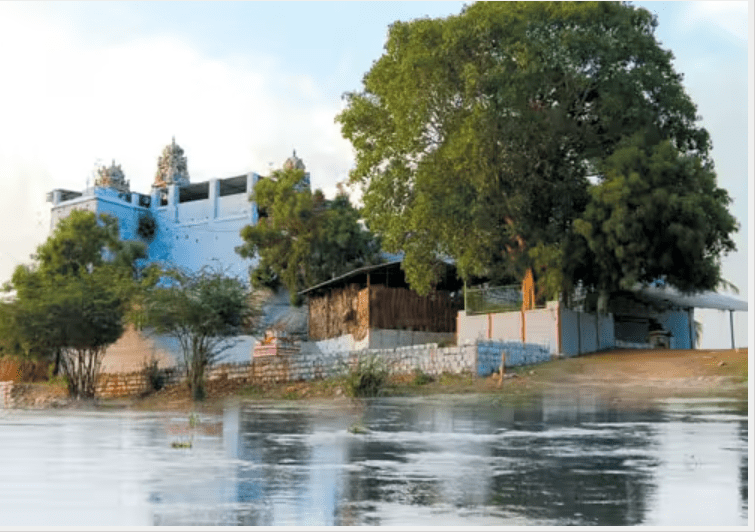
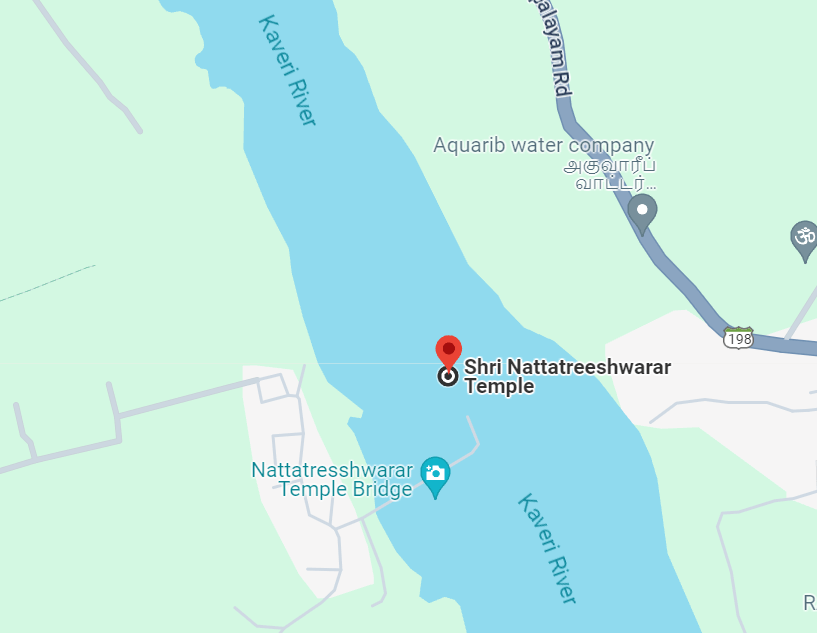
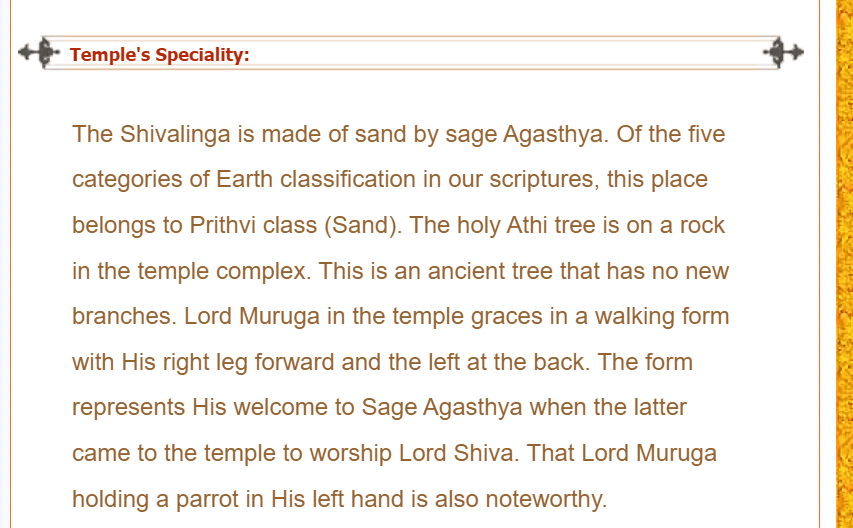
Nattatreeshwarar is known as the Nabhi Pradesha of river Kaveri. It is the mid point between the origin at Talakaveri and Poompuhar where she merges with the sea. Here, it is said that, Agastya muni installed a sand shiva linga. The story goes as follows.
Once, there were two powerful demons named Ilvala and Vatapi. They were brothers and possessed mystical powers. Together, they wreaked havoc on the world and killed people.
Ilvala and Vatapi had a sinister scheme to deceive and kill people. Ilvala would transform Vatapi into a ram, and then Vatapi would be served as meat to sages and ascetics. After the meal, Ilvala would call out for his brother Vatapi saying ‘Vaatapi Attraagaccha‘, and Vatapi would tear through the stomach of the person who had eaten him, killing them instantly. This dreadful practice continued for some time, and many sages fell victim to their deceitful plan.
One day, Sage Agastya, a revered sage known for his wisdom and spiritual prowess, came across Ilvala and Vatapi. Ilvala invited Sage Agastya to their home and offered him a meal, intending to execute their malevolent plan.
Unbeknownst to the demons, Sage Agastya possessed extraordinary powers and divine insight. He agreed to dine with them but remained aware of their treachery. As expected, after consuming the meal, Ilvala called out for Vatapi to emerge from the sage’s stomach.
However, Sage Agastya, with his spiritual powers placed his hands on his stomach and uttered ‘Vatapi Jeernobhava’ thus neutralizing Vatapi’s ability to reform. Consequently, Vatapi was digested by the sage’s stomach, unable to cause any harm. He also kills Ilvala by using his divine powers. Thus, the demons’ scheme was foiled, and they were unable to continue their wicked practices. To get rid of sins incurred by killing the demons, sage Agastya installs a shiva linga at Nattatreeshwarar.
You can find the information about the temple from the site https://temple.dinamalar.com/en/new_en.php?id=822
Akhanda Kaveri
Kulitale is a town in TamilNadu on the banks of river Kaveri. Here she flows as Akhanda Kaveri. It is the widest point in the course of the river. Her width is nearly 1 km at this point. On the banks of akhanda kaveri is the famous Kadambar Kovil shiva temple.
Antya Ranga/2nd Pancharanga –SriRangam Ranganatha kovil
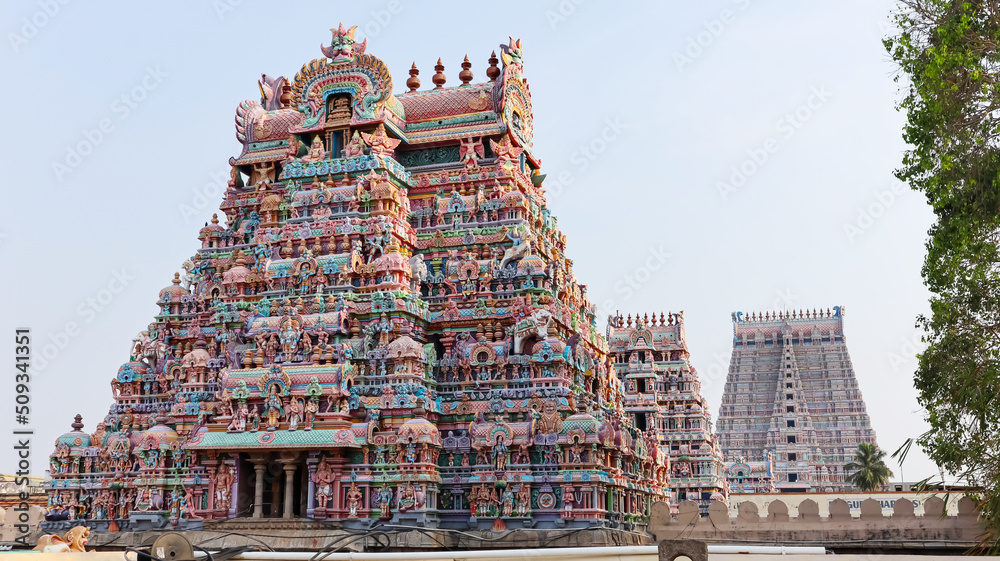
SriRangam is an island in Tamilnadu between the rivers Kaveri and Kollidam. It is famous for Sri RanganathaSwamy temple and is an UNSECO heritage site. This temple complex is also known as Bhoo Vaikuntam. It is very massive and has 7 prakarams (seven concentric enclosures with courtyards). The outer two prakarams are residential and markets with shops, restaurants and flower stalls. The five inner courtyards have shrines to Vishnu and his various avatars such as Rama and Krishna. Major shrines are additionally dedicated to goddess Lakshmi and many saints of Vaishnavism. There is a ritual of doing prakara namaskaras starting with outer enclosure and moving towards inner enclosure. While few people also do the prakara namaskara starting with inner enclosure and moving towards outer enclosure.
The idol of the main deity is unique that it is not made of granite as in many temples, but Stucco (a unique combination of lime, mortar and stones bound together by a special paste (Thailam), made of musk, camphor, honey,Jaggery and sandal).
The temple has 21 colourful gopurams, 50 sub shrines, 9 sacred pools, gilded Vimana (dome) over the sanctum sanctorum of the presiding deity, and other interesting features such as fresco paintings. The Rajagopuram is the second tallest Temple tower in the world rising to a height of 72 mts.

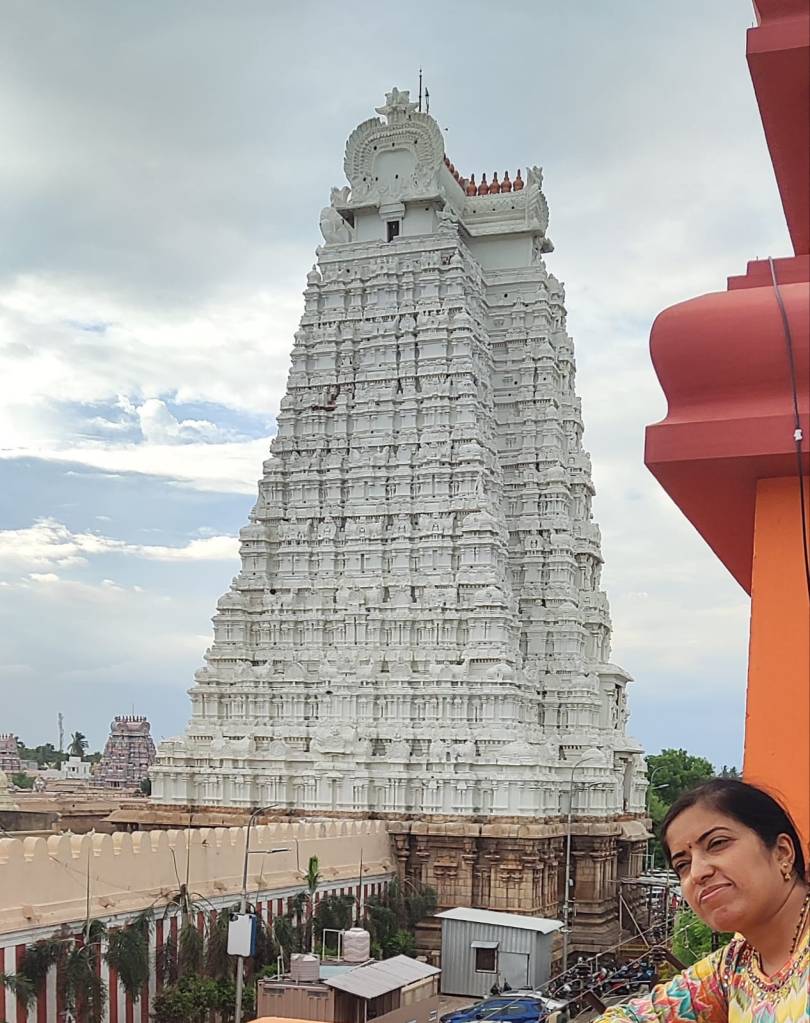
On the east side of the temple is a white gopuram known as the Vellayi Gopuram. It has been named after a dancer called Vellayi/Vellaiyammal who had sacrificed her life to protect the idol of Namperumal from the Sultanate forces who had invaded the temple.
The Temple complex has 2 large Temple tanks inside it, Chandra Pushkarini and Surya Pushkarini. The Complex has been built in a way that all the water collected flows into the tanks. The capacity of each Pushkarini is around 2 million litres and the water is cleansed by action of fishes in it.
The temple also houses a 1000 pillar mandapam. It is said that this mandapam was constructed by the Vijayanagara kings. A very important point to be noted here is that every dynasty that ruled over the region, starting with Cholas who first built the temple then the Pandyas, Hoysalas, Marathas and Vijayanagara dynasties, made significant contributions towards the expansion of the temple. Inscriptions from each dynasties can be found in the temple complex.
In the Ranganthaswamy temple, there is a shrine dedicated to Shree Ramanujacharya. The purportedly preserved mortal remains of Shree Ramanujacharya in Upadesa Mudra can be found inside the temple.


 Bliss-Girls
Leave a reply to Jyothika Cancel reply